We’ve been committed to measurable impact from day one.
At Instagrid, impact means accountability: supporting the people on the ground today while helping drive the transition to cleaner energy tomorrow. That’s why we focus on evidence-backed results, not vague claims.
The need for cleaner alternatives is clear. One hour of using a combustion generator can produce the same NOx emissions as driving a car 250 km. Clean, reliable portable power helps create healthier, quieter and more efficient work environments wherever work happens.
But impact doesn’t stop at the point of use. At Instagrid, we see sustainability as an ongoing journey built on transparency, circularity and measurable progress. So, what happens to equipment at the end of its life? For sustainability, fleet and procurement teams, that question is now part of the purchase decision, and the answer feeds straight into net zero reports.
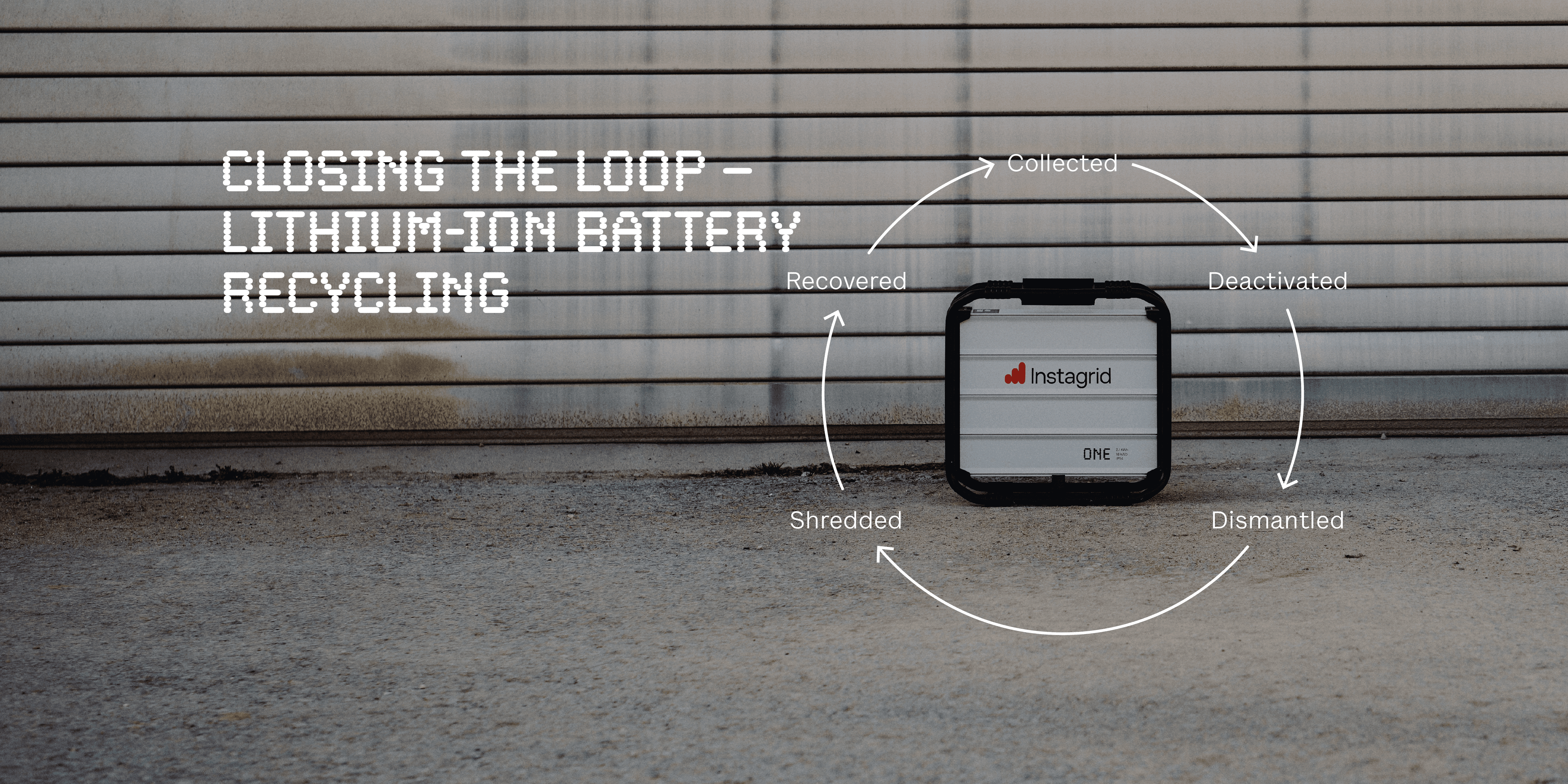
Our white paper, Closing the Loop: Lithium-Ion Battery Recycling and Take-Back in Europe, shares what we learned when taking Instagrid ONE through real recycling processes, including the parts the industry tends to skip.
What the recycling trials showed
Together with several recycling companies we evaluated both the theoretical, and in practice recycling process of an Instagrid ONE unit. The objective was to gain hands-on insights into different recycling technologies and the specific processing steps applied to Instagrid’s battery systems and modules, to identify opportunities and challenges in material recovery, and obtain feedback on recyclability and achievable recycling efficiencies.
In short: Instagrid ONE is designed for disassembly, recyclable in existing industrial plants and delivers a high recyclability rate.
Instagrid’s design makes the difference. The modular build enables recyclers to disassemble units without product-specific instructions, which they confirmed is safer and more efficient.
From the trials and our own research, we derived a best-case material recovery rate of 73% by mass for Instagrid ONE – rising further when we include energy recovery, meaning up to 91% of the product can be diverted from landfill. The rates are based on material composition and recycling routes available under ideal conditions. Metals recover well; the largest losses are in electronics and plastics.
Recyclable is not the same as closed loop
Now the honest part. Being recyclable is not the same as closing the loop. Europe already has significant recycling capacity that exceeds current return volumes; the harder problem is getting used units back into the recycling system.
Return volumes are scattered, the material is classified as hazardous waste, and cross-border logistics make large, centralised take-back schemes complex and costly.
The distinction, between what can be recycled and what can realistically be collected, is widely overlooked, and it’s muddied further by an often-quoted figure that only 5% of lithium-ion batteries are recycled. That number is outdated. It reflects context-specific collection data, not the material recovery that is achievable through established recycling processes.
Our research shows the bottleneck is take-back, not technology.
What this means for Instagrid and your organisation
Our team has assessed its preferred take-back scenario — centralised return with full downstream transparency and control over material flows. However, at present, this model is not economically or organisationally feasible at scale. Instead, we participate in established national take-back schemes*: legally compliant, and minimal effort for end users, and in line with the EU Battery Regulation and Extended Producer Responsibility.
In total, we provide customer friendly take-back solutions in 29 countries across Europe, North America*.
And it’s important to point out - 29 countries is a foundation, not a finish line.
The honest trade-off: the current available national schemes limit our transparency over downstream material flows. The digital battery passport, mandatory under the EU Battery Regulation from February 2027 for industrial batteries above 2 kWh, should help, and we remain committed to continually monitoring the market and engaging in initiatives that support the development of more established and widely accessible takeback systems.
How does portable power recycling compare with a diesel generator?
Portable battery power gets asked about recycling far more often than the diesel generator it replaces, which is worth sitting with.
Small petrol and diesel generators are often neglected at end of life because their low scrap value, the hassle of safely draining and disposing of fuel and oil, and the lack of take-back schemes mean there’s too-often no clear route for recovery.
Instagrid’s portable power supply is built to be taken apart, so its materials can be recovered, and end-of-life take-back is already arranged*. In a world reliant on power, where businesses are increasingly conscious of how all equipment, especially the battery-based products, are disposed of - taking responsibility for waste matters.
Of course, the biggest difference shows up every day an Instagrid unit runs. A diesel generator burns fuel and emits fumes, polluting the air every minute it’s in use. Over the full life cycle, our certified Life Cycle Assessments show up to 94% lower greenhouse gas emissions than a generator with a similar load profile, and zero local emissions at the point of use.
But to truly close the loop, the end-of-life process cannot be ignored. That’s the difference Instagrid strives to make.
To get the full picture, the trials, the numbers and the case for a better return system download our new whitepaper: Closing the Loop
Our Impact report and take-back options can be found on our Impact Page or email the address below.
*Take-back solutions: We provide take-back solutions in 29 countries, ranging from national collection schemes to return options we organise ourselves. Take-back is free of charge for all units bought directly from Instagrid, and in Germany it is free for our reseller partners and their customers too.
Outside Germany, our authorised distribution partners handle the take-back for the units they sell. If you bought your Instagrid battery system through a partner, please check with them which options they offer.
In North America (US and Canada), take-back programmes vary by state.
To find your local take-back options, email sustainability@instagrid.co and we’ll be happy to help.