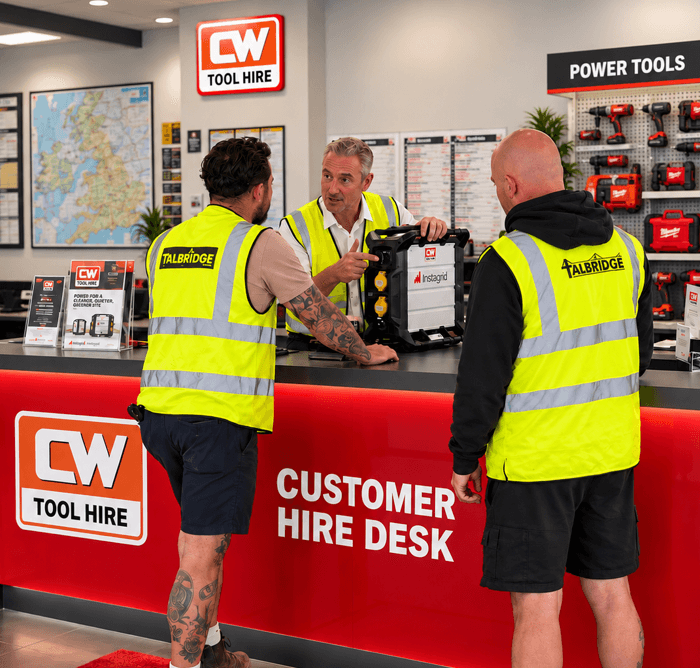
Charles Wilson (CW) Plant is making the switch to cleaner, portable power. The company has invested in more than 40 Instagrid battery power units to help customers combat rising fuel prices and meet increasingly stringent sustainability targets.
We sat down with Paula Godfrey, one of the CW team instrumental in driving the investment, to find out more...
How did Instagrid first come onto your radar, and what moved it from something you'd heard of to something you were prepared to put fleet money behind?
We use Seddon Plant and Engineers for various equipment and have a strong working relationship with them. So when Rob asked us to look at Instagrid as a replacement for small generators, we knew he'd only recommend something that could offer genuine commercial value to Charles Wilson Hire.
As with any change, there was scepticism. We offer generators ourselves - but hadn't looked at small portable battery equipment before and wondered whether there would be demand for it.
When we spoke with our events team, however, they were already aware of the product - and already hiring it. That accelerated the decision considerably.
We trialled a unit first, and the feedback was excellent. Combined with our desire to invest in products that are sustainable and future-proof, that made the decision to invest an easy one.
The customer benefit is obvious - silent, portable power with no wet fuel and less manual handling. How has the investment benefited Charles Wilson Hire?
The sustainability element is a selling point and a genuine benefit to both Charles Wilson and our customers. Instagrid fundamentally makes your entire fleet of corded tools and equipment sustainable, while also increasing portability.
It's incredibly versatile - it can be used indoors and outdoors - and we see that as a huge benefit. It opens up new opportunities and represents a future-proof investment, especially as more of our customers are looking to move away from petrol- and diesel-powered sources specifically.
Charles Wilson and Seddon Plant had a relationship long before Instagrid came into it. How much did that count when Seddon’s put a genuinely different type of product in front of you?
We've worked with Seddon’s for a long time. The trust is there.
Instagrid 's portable power supplies are a product that sells itself, and that's exactly why we choose supply chain partners like Seddon’s - we know they do the diligence and invest in quality products that genuinely benefit their customers. They'd already carried out their new product implementation process, they know our business, and they understood how it would fit. That made the whole process straightforward.
What types of jobs or sectors are you deploying the Instagrid units on, and which has surprised you most in terms of how well it works?
The uptake has been exceptional among our event customers, with some taking up to ten units to manage power through the build and breakdown stages. They're working in fields, generators slow them down, laying cable is time-consuming, and they fundamentally need to be in control of their power to meet extremely tight deadlines. Instagrid gives them that - and the uptake really shows it.
Adoption in construction has been a little slower; the shift away from generators is proving a tougher change to make. But once people try the product, they don't want to go back.
We have further training planned with our internal teams to support that education, and we're uncovering new use cases all the time.
Has there been a job where you genuinely couldn't have taken it on without an Instagrid unit — a site restriction, noise limit, or emission zone that ruled out a generator entirely?
Yes - and there are probably many examples. One that stands out is a customer who approached our sales team needing silent power for night work. Generators weren't an option and there was no mains supply available. Instagrid was the perfect solution. They were able to keep their customer happy, working through the night to screed a floor, with Instagrid GO 110v powering both the lights and the equipment.
What have your customers actually said once a unit turns up on site - and has anything surprised you? Have units been asked for by name on the next hire?
Feedback has been consistently positive. Instagrid units give customers the freedom to power their work on their own terms. They love the fact they can pick it up and carry it wherever they need power - inside or out. It really is a portable, universal plug socket.
Change isn't easy, especially in the hire industry. How have you managed the internal transition from generators to Instagrid - what's changed operationally, and how are you handling internal education?
Educating our teams, and our wider customer base - on the products Charles Wilson provides is an ongoing challenge; we have thousands of product lines.
The events sector has moved quickly, and our sales team has been very proactive in recognising the doors this product can open. When customers are looking for a power solution, our team is proud to put Instagrid's portable power systems forward. They overcomes so many of the challenges around sourcing power on event builds.
Our sales team have started carrying units with them to customer visits, and the practical demonstration has been a real winner. Once a customer sees how it can improve their working day, they want to try it - and often don't want to give it back.
We still have work to do on internal education, but both Seddons and Instagrid are supporting us with training for our teams. Getting hands-on with the equipment you're recommending is so important, and I see that training as key to the ongoing education that will benefit everyone going forward.
Do customers see the full cost picture of an Instagrid unit versus a generator — when you factor in fuel, servicing, transport, and the admin overhead of managing generators?
There's no getting away from the fact that an Instagrid unit costs around double the weekly hire rate of a generator. But that's only part of the picture.
More and more customers are looking at the wider costs, and with fuel prices rising, the case for Instagrid becomes easier to make. A typical recharge costs around 50p from a mains supply. There's no handling or transporting wet fuel, no sending someone out to refuel, no deploying two people to move a generator or lay cable. No extraction fans, no plant nappies, no spill kits. All of those extras add up quickly - in time, wages and materials.
This is still a step change from a way of working that's been the default for decades, so it won't happen overnight. But the industries we serve are increasingly looking to work smarter, more sustainably and more safely - and that makes Instagrid a much easier sell than it was even a year ago.
How has the support been since the units went into the fleet — from handover and training through to anything that's needed resolving since?
At the beginning, you naturally have questions - it's a new product - and Rob Collins (Seddon Plant and Engineers National Account Manager) has been brilliant throughout.
The units have IoT tracking built in, which has been a huge selling point. Not just for customers who want to monitor their own energy usage and manage their equipment more effectively, but for our own fleet management too. The IoT enables units to be tracked to within three metres - so if something can't be located on site, you log on and find it. Even if it's out of charge or switched off. For any rental company, that's an enormous benefit.
If another hire company asked you straight out whether Instagrid was worth the investment, what would you tell them?
I'd say go for it. Our customers trust Charles Wilson to bring them products that work — the latest innovations and genuine solutions to real problems. Instagrid is all of that.
Beyond the commercial case, there are the sustainability benefits, the safety improvements, and the manual handling advantages. It requires nothing beyond a visual inspection, a quick recharge post hire – and an annual PAT test. Compare that to generators, which can be notoriously problematic on site and demanding when it comes to servicing and maintenance.
It's an investment that's already proved itself with our customers. Once they've tried it, they don't want to go back to a generator.
Interested in making the switch to cleaner, portable power?
Charles Wilson has units widely available for hire across the UK – to enquire visit their website
Or want to purchase? then contact our team, or find your local distribution partner on our here