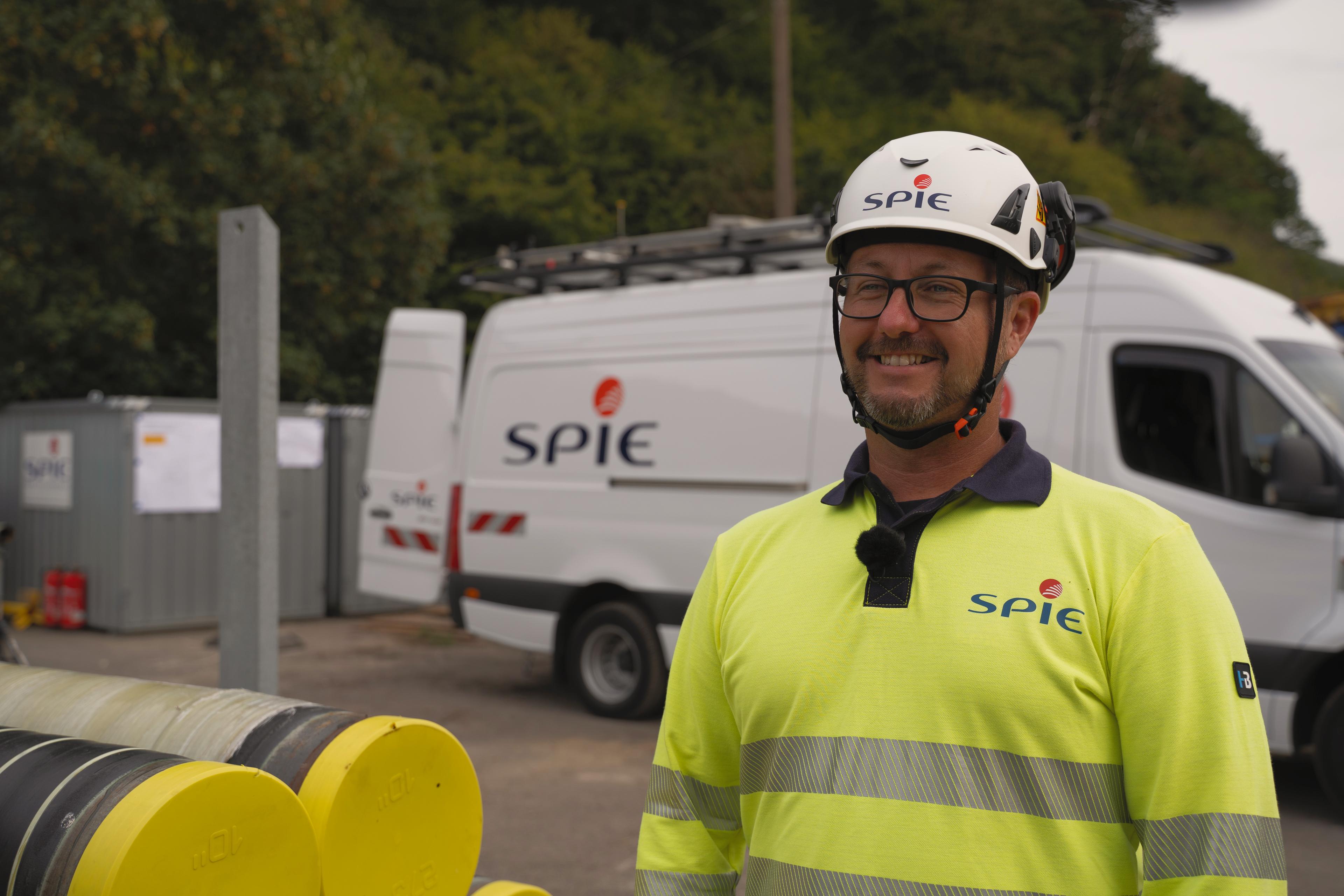
SPIE Germany Switzerland Austria builds the infrastructure for the energy transition and also wants to reduce CO₂ emissions on its own construction sites. In the testimonial, Rocío de la Cruz García, Sustainability Director, and Sven Bönig from the Iserlohn site explain the role Instagrid plays.
Watch the full testimonial
Who is SPIE?
SPIE Germany Switzerland Austria is part of the SPIE group, the independent European leader in multi-technical services for buildings, industrial facilities and infrastructure. More than 20,000 people at 750 locations serve over 23,000 customers, from substations and high-voltage lines to charging infrastructure and technical facility management. In doing so, SPIE also holds itself to account. To that end, the company has set clear climate targets for 2030, validated by the Science Based Targets initiative (SBTi):
50% lower absolute Scope 1 and Scope 2 emissions by 2030 (vs. 2019)
55% lower Scope 3 intensity by 2030 (vs. 2019)
According to the group’s 2025 figures, direct emissions were already 30% below the 2019 level at the end of 2025. The biggest lever is the vehicle fleet, of which 39% was electric at the end of 2025.
Rocío de la Cruz García, Sustainability Director at SPIE Germany Switzerland Austria, explains why Instagrid ONE fits this strategy:
“To me, this is a good example of how we take our role as an enabler for climate protection and the energy transition seriously and live it on our own construction sites. Because transformation doesn’t begin somewhere else, but where we work every day.”
The challenge on site
Sven Bönig is Head of Underground Pipeline Construction at SPIE’s Iserlohn site. His teams often work in places without a power connection, such as in excavation pits or at the end point of a construction site. Anyone who needed power there previously had to bring vehicles with an underfloor generator and (diesel) generator sets to the point of use. Besides the resulting CO₂ footprint, this costs time and effort. That is why Sven looked for a more mobile solution that brings the power directly to where it is needed.
How SPIE uses Instagrid solutions day to day
Today, the team works with several Instagrid products. Instagrid ONE is the portable power supply for everyday use on the construction site. With Instagrid LINK, the team connects several Instagrid ONE and runs several loads at the same time. Instagrid LINK MAX is used for larger welding applications. Further tasks include powering pumps to empty trenches, and lighting for places where no work is taking place but which need to be lit, for example to secure the construction site.
For Sven Bönig, this means one thing above all:
“With Instagrid products, we can supply power in places where we previously couldn’t get it so easily.”
What it brings in everyday work
SPIE sees several benefits in daily use:
More flexible as a system: Teams adapt their power supply to every task, from lighting to welding.
Predictable runtime: How long a unit lasts depends on the task. Sven’s team members usually get by with one charge for 1 to 3 days.
Quiet and mobile: The systems are quiet and easy to transport, so they can be taken from one excavation pit to the next.
Free of noise and emissions: Power flows where it is needed, without noise and without emissions on site.
Rocío de la Cruz García adds what this means for SPIE:
“With Instagrid’s mobile battery systems, our teams on construction sites can do without diesel generators and still work reliably and efficiently.”
Bring this power to your job site too. Talk to our team and find out which Instagrid solution fits your projects.